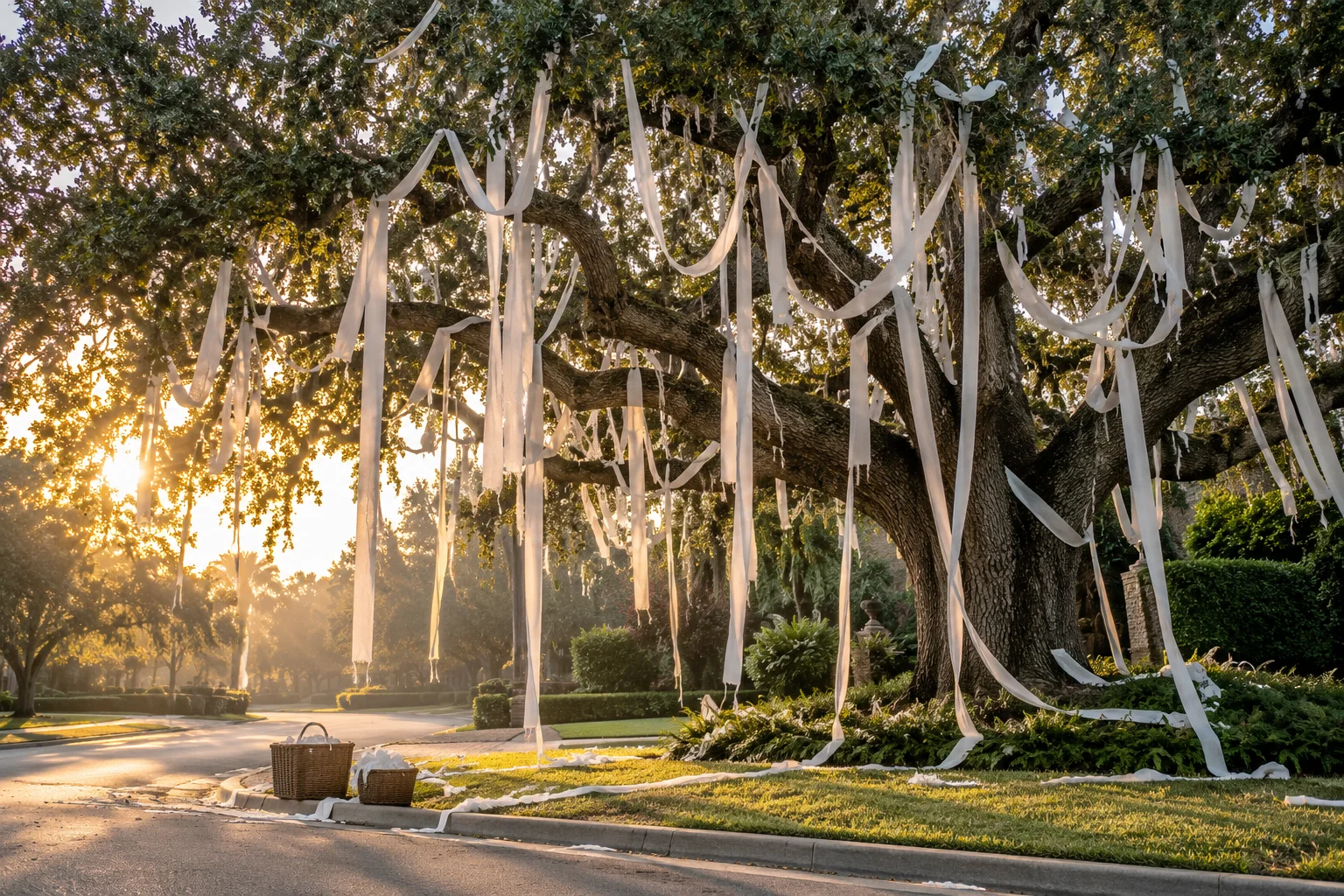
FAIRHOPE, AL — A fictional Fairhope neighborhood has adopted new sustainability standards requiring all Halloween tree rolling to be performed with certified organic toilet paper.
The voluntary-but-enforceable guidelines prohibit conventional two-ply, scented varieties and any roll whose supply chain cannot be explained at the curb.
“We support youthful mischief,” said imaginary neighborhood sustainability chair Caroline Canopy. “We simply believe it should be responsibly sourced, visually restrained and gone before the irrigation system comes on.”
Approved paper must be chlorine-free, septic-safe, packaged without plastic and manufactured from either recycled fiber or bamboo that has never met a panda.
Residents who wake to find their live oak covered in standard warehouse-club tissue may file a complaint through the neighborhood’s seasonal materials portal.
A more thoughtful form of vandalism
The guidelines grew out of concern that traditional tree rolling produces excessive waste, leaves micro-perforations in the streetscape and occasionally introduces an unapproved shade of white.
Under the new program, teenagers may obtain a Mischief With Stewardship permit allowing them to roll up to three trees between 9:30 p.m. and midnight.
Each group must carry reusable tote bags, avoid nesting birds and appoint one participant as a leave-no-trace liaison.
Participants are encouraged to throw from the shoulder rather than the wrist, reducing the number of failed rolls that land in the azaleas.
“The old method was chaotic,” said fictional parent Davis Parchment. “This gives the children structure while preserving the sense that they have escaped our supervision.”
Parchment purchased twelve rolls of small-batch, unbleached tissue from a pop-up stand offering tasting notes and a map of the mill where it was produced.
The paper was described as soft, tensile and “quietly disruptive.”
Arborists available by reservation
Mature live oaks may only be rolled under the supervision of a consulting arborist who can identify load-bearing limbs and recommend a paper weight appropriate to the canopy.
Crepe myrtles are classified as beginner trees. Magnolias require intermediate skill. Newly planted ornamental trees are off limits until they have survived two summers and one neighborhood landscaping review.
Several households have reserved arborists for the evening, creating concern that unscheduled teenagers may be unable to secure professional oversight during peak rolling hours.
“I remember when you could just throw a roll into a tree,” said imaginary longtime resident Earl Cotton. “Now you need an appointment, a fiber declaration and somebody with a reflective vest.”
Cotton later conceded that the reflective vest was helpful.
Cleanup becomes competitive
The morning-after cleanup must begin by 7 a.m. and use only wooden ladders, electric utility carts and beverages served in reusable cups.
Collected paper will be weighed, composted and reported in the neighborhood newsletter alongside an estimate of how much conventional vandalism was diverted from the landfill.
The household with the cleanest recovery will receive a small brass plaque reading THIS TREE WAS ROLLED RESPONSIBLY.
Some residents have already begun competing for the honor.
One family installed discreet landscape lighting to improve cleanup visibility. Another hired a documentary photographer to capture the paper at sunrise before removal.
Canopy said the program should not be viewed as an attempt to turn spontaneous adolescent behavior into a curated community experience.
“No one is curating anything,” she said while adjusting a linen-covered check-in table beneath a sign reading ORGANIC ROLLS — REGISTERED PARTICIPANTS ONLY.
At press time, a group of teenagers had abandoned the neighborhood after discovering that every tree they intended to roll had already been professionally styled for the photographs.
They left behind a handwritten note promising to return next year with conventional paper.
The note was recycled.