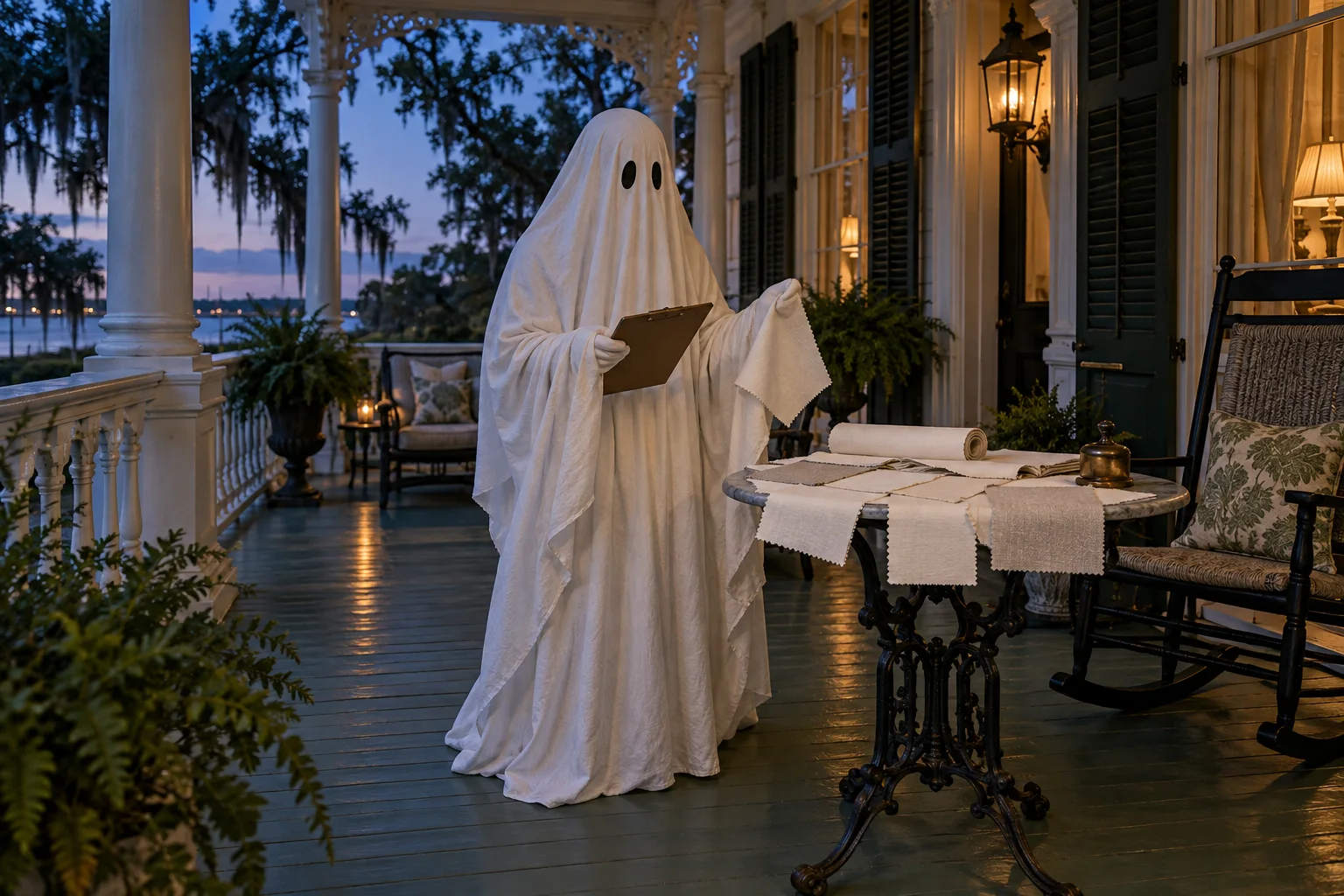
FAIRHOPE, AL — A fictional historic-character committee has denied a ghost permission to appear on a downtown porch after determining that its costume was inconsistent with the period of significance.
The ghost, who identified itself only as “a restless presence associated with the east bedroom,” applied to haunt the property on Halloween night.
Committee staff recommended denial after discovering that the apparition’s white sheet was 400-thread-count Egyptian cotton purchased during a seasonal bedding sale.
“The applicant is asking us to believe this material has been floating around since 1894,” said imaginary preservation officer Clara Cornice. “The fitted corners alone tell a different story.”
The ghost responded by rattling a chain and lowering the room temperature four degrees.
The committee entered both actions into the record.
Period-appropriate haunting required
Under the fictional guidelines, supernatural activity within the historic district must be compatible with the architectural character of the structure being haunted.
Victorian homes may support unexplained footsteps, candle flickering and distant piano music. Craftsman houses are limited to restrained knocking, built-in shadow movement and the occasional door that closes with honest materials.
Mid-century properties may feature cold spots, but only if they are horizontally oriented.
The ghost’s application proposed a full-body sheet appearance, intermittent moaning and one dramatic passage through the porch wall.
Staff said the wall passage would alter the visual rhythm of the facade and recommended using an existing door.
“We are not opposed to ghosts,” Cornice said. “We are opposed to ghosts who refuse to work within the established openings.”
Applicant disputes the evidence
Through a fictional paranormal consultant, the ghost argued that it had occupied the house for more than a century and should therefore be considered a contributing presence.
The consultant submitted several photographs showing a faint white shape near the staircase. Committee members agreed the images demonstrated age but questioned whether the shape was original to the property.
One member requested a materials sample. The ghost declined, citing bodily integrity.
Another asked whether the chains were hand-forged. The ghost stopped rattling them.
Public comment was divided.
Several neighbors supported the haunting but asked that moaning end by 9 p.m. Others worried that approval would establish a precedent for specters with no documented connection to the neighborhood.
“We moved here for the historic charm,” said fictional resident Margaret Transom. “That does not mean any recently deceased person can drift in and start lowering property values.”
A path to approval remains
The committee offered the ghost several alternatives, including period-correct muslin, a less visible attic location and a one-year provisional haunting limited to interior spaces.
It may also resubmit the application with archival evidence, a spectral site plan and a color photograph showing the proposed apparition against the porch during daylight hours.
The ghost’s consultant said daylight photography would present practical difficulties.
Committee members expressed sympathy but noted that similar requirements apply to everyone.
After the unanimous denial, the ghost vanished through the ceiling without approval.
Staff immediately issued a notice of violation.
The following morning, the notice was found turned backward inside a locked room.
Cornice said enforcement could take several months.
“It is difficult to serve someone who is both deceased and not on the tax rolls,” she said. “But the integrity of the district depends on consistency.”
At press time, the ghost had relocated to a newer subdivision where the architectural review process approved its sheet after confirming it was one of six permitted whites.