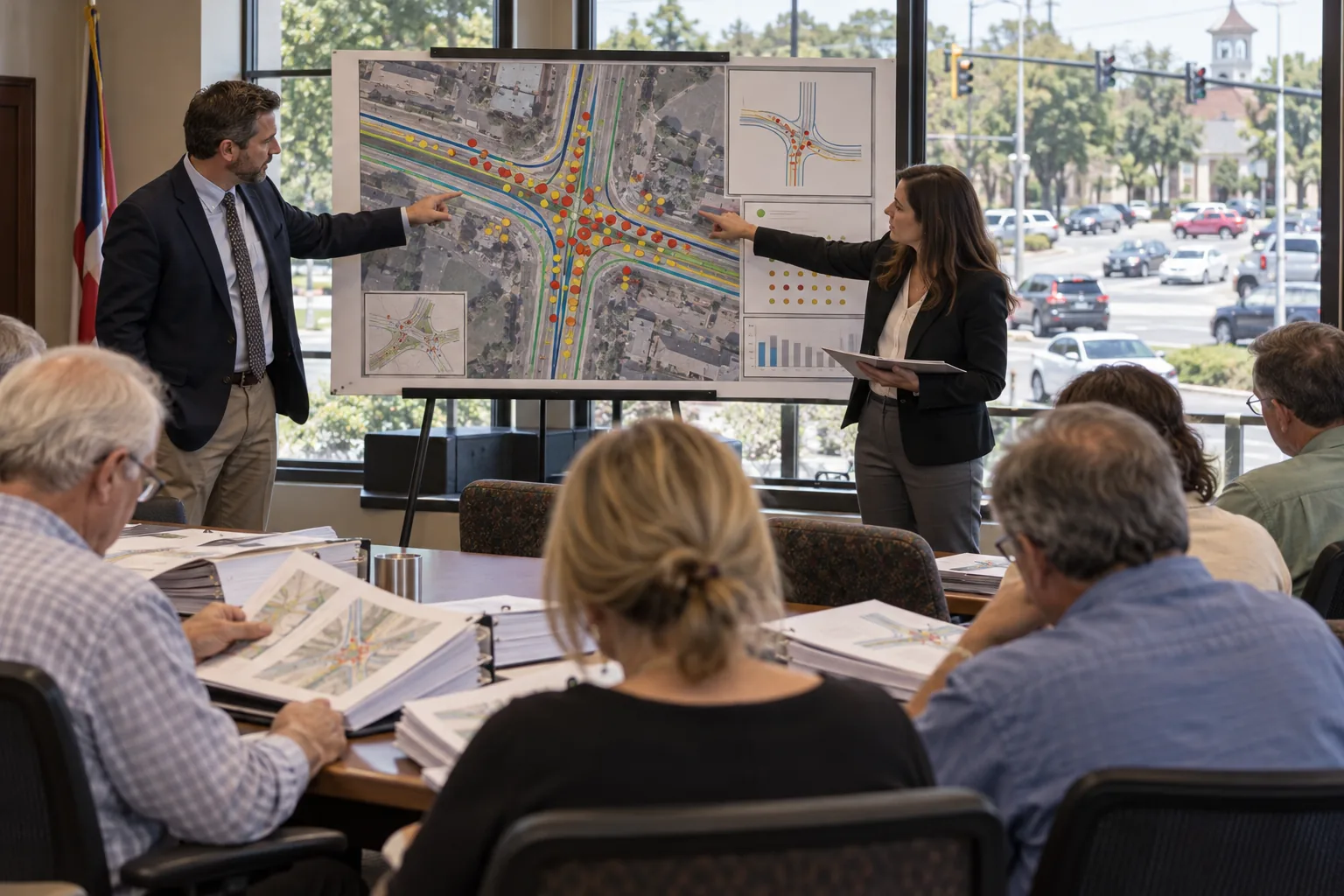
FAIRHOPE, AL — A long-awaited traffic study presented to Fairhope planners Monday confirmed that automobiles currently exist and may continue appearing on local roads if additional homes are constructed.
The 184-page report examined seventeen intersections, nine turn lanes and one increasingly emotional four-way stop before reaching its central finding: people occasionally leave their houses.
“This is an important discovery,” said fictional traffic consultant Lane Merge. “Previous models assumed residents would purchase homes and remain inside them indefinitely.”
Researchers found that a proposed 400-home development could introduce additional vehicles during morning and afternoon hours, particularly when residents travel to work, school, stores, restaurants or nearly anywhere else.
The study described those periods as “peak traffic events.”
Conditions should be monitored
Consultants counted cars on a Tuesday, evaluated turning movements and produced several maps in which busy intersections appeared red.
Commissioners expressed concern about the red areas.
Merge assured them that the colors were primarily illustrative and could be changed to a more calming shade before final approval.
The report recommends monitoring conditions after construction, followed by additional monitoring if the original monitoring confirms what residents predicted before the first study.
Possible improvements include a turn lane, a future signal and encouraging drivers to use another road.
Residents noted that the other road is also congested.
“We accounted for that,” Merge said, moving his pointer to a third road.
When informed that the third road floods, the consultant zoomed the map out until Mobile became visible.
The study also concluded that the project would create only a modest delay when averaged across an entire day, including the hours between 2 and 4 a.m. when few residents are attempting to turn left.
Several fictional neighbors questioned whether the analysis reflected school traffic, tourist traffic, construction traffic or the seasonal arrival of everyone who has decided to visit downtown simultaneously.
The consultant said those issues would be appropriate subjects for Phase II.
Planning officials thanked the firm for its comprehensive work and accepted the finding that traffic could increase if more drivers are added.
The development will now proceed to its next review stage, where drainage experts will investigate whether water continues to move downhill.
The study reached a definitive conclusion.
Adding homes may also add cars.