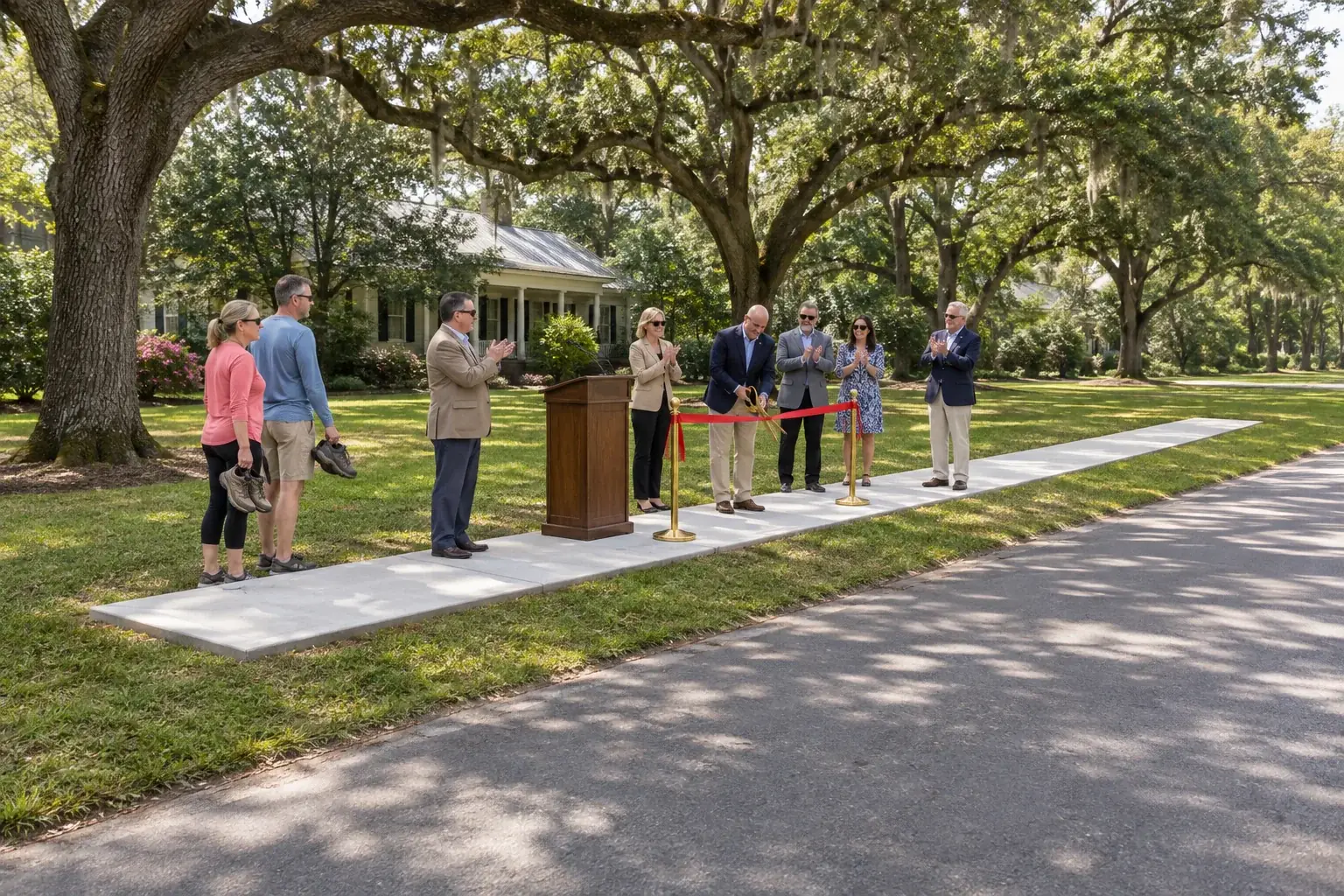
FAIRHOPE, AL — Fairhope officials cut the ribbon Friday on a fictional 120-foot sidewalk connecting one patch of roadside grass to a second, slightly more easterly patch of roadside grass.
The isolated concrete segment is being celebrated as the first completed phase of the city’s Walk Until You Cannot plan.
“For nearly two full minutes, pedestrians will have a safe, level place to be,” said imaginary mobility coordinator Walker Short. “Then they can make an informed transition back into the grass.”
The sidewalk begins without warning near an oak tree and ends with equal confidence beside a drainage ditch.
Complete end-to-end experience
Friday’s ceremony included an inaugural end-to-end walk led by officials, engineers and two residents carrying their off-road shoes.
Participants traveled the entire route in thirty-seven seconds, paused for the formal turnaround and returned to the podium before the opening remarks had concluded.
“It really changes how you experience this portion of the block,” said fictional resident Penny Stride. “Previously I walked in grass. Now I walk on concrete, then grass, then the same concrete on the way home.”
At each endpoint, a painted symbol will remind pedestrians to resume traditional Fairhope roadside navigation: watching for traffic, stepping around standing water and pretending the shoulder is a pedestrian facility.
The city considered adding ramps where the sidewalk ends but determined the grass is already at grass level.
Connectivity planned conceptually
The nearest existing sidewalks are several hundred feet away. Officials said this does not make the new segment disconnected; it makes the future connections especially important.
A conceptual map shows the sidewalk eventually linking to a larger network through a series of dotted lines, arrows and the phrase “BY OTHERS.”
“Every connected sidewalk begins as a sidewalk that is not connected,” Short explained. “This one is simply preserving that first phase.”
Developers of adjacent properties may be required to add more segments over time. At the projected pace, residents could walk continuously to the nearest corner sometime after the current concrete develops historic significance.
Until then, the city has installed a small bench at the eastern terminus for pedestrians who need to recover before attempting the lawn.
New rules for short walks
Because the sidewalk is limited in length, users must reserve peak walking times in advance.
Northbound pedestrians receive priority during even-numbered minutes. Southbound pedestrians may enter after confirming that nobody is approaching from the other patch of grass.
Jogging is discouraged because runners could leave the transportation system before city staff records their arrival.
Dogs are welcome but must remain on a leash short enough to prevent them from reaching unimproved right-of-way ahead of their owners.
The city is also studying whether the sidewalk qualifies for a crosswalk. The nearest crossing destination is currently an azalea.
A foundation for tomorrow
Officials described the project as a meaningful investment in walkability and a visible reminder that transportation networks are assembled one unrelated requirement at a time.
At press time, a family attempted to use the sidewalk for an evening stroll but completed it before everyone had left the house.
They decided to continue through the grass.
Short called the trip a multimodal success.