FAIRHOPE, AL — Fairhope’s fictional Department of Acceptable Moisture introduced a new drainage standard Friday requiring development to leave surrounding properties no wetter than residents have already learned to expect.
Under the “No Worse Than It Already Is” program, construction may proceed after engineers confirm that stormwater will continue reaching the same yards, flower beds and emotionally significant low spots it reached before.
“We are not promising dry,” said imaginary municipal hydrologist Wade Deeper. “Dry would require a separate capital-improvement plan. We are promising familiar.”
The standard establishes existing flooding as the baseline against which all future flooding will be favorably compared.
Every puddle receives a benchmark
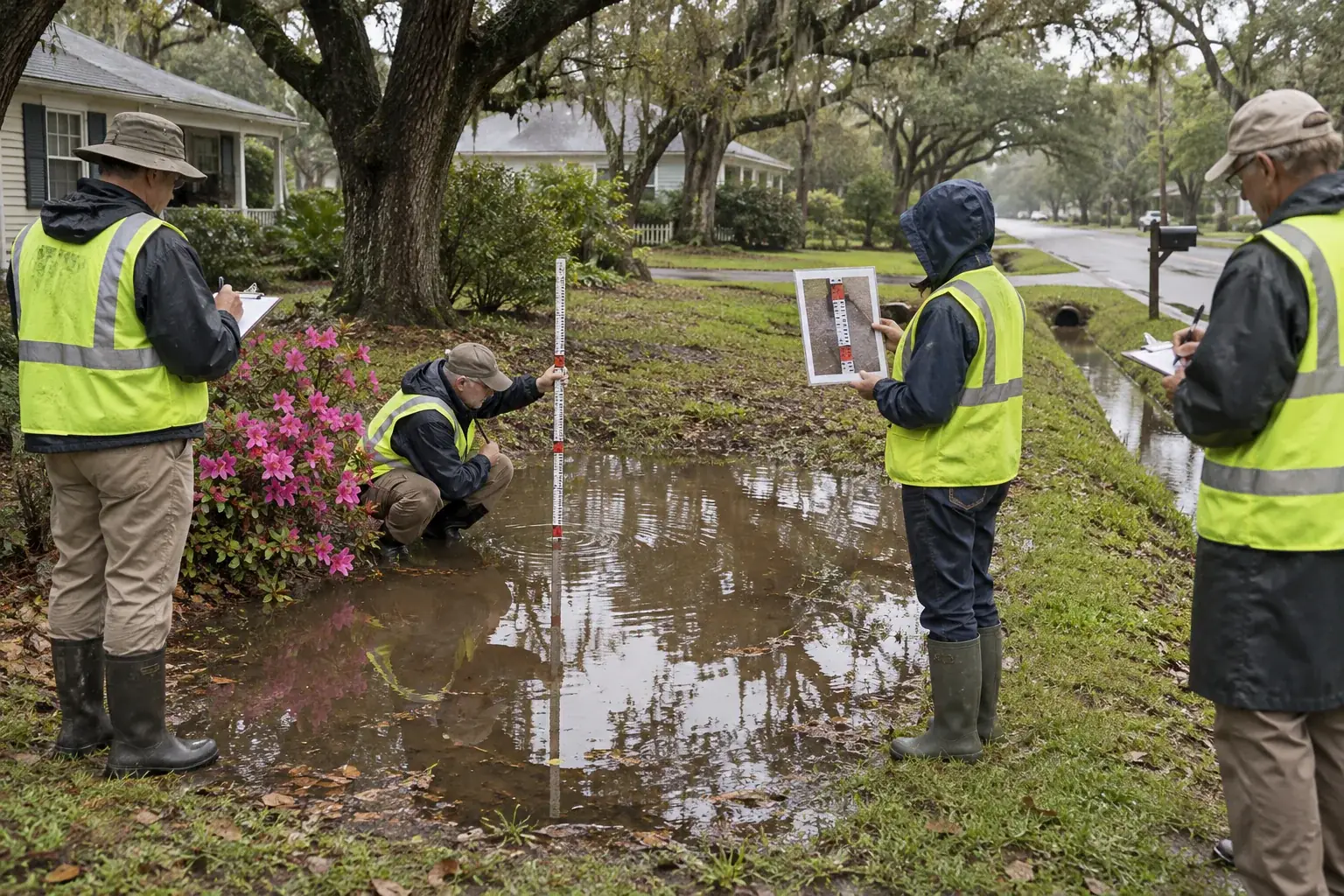
Inspectors will photograph neighborhood puddles from approved angles and install small brass markers showing their historic high-water levels.
Residents may report a violation when a puddle exceeds its marker, enters a room it has not previously entered or begins attracting waterfowl from outside the planning jurisdiction.
A puddle remaining within its traditional footprint will be classified as “hydrologically compatible,” even if that footprint includes most of a driveway and one azalea.
“That azalea has been wet for years,” Deeper said. “At this point, the water has neighborhood character.”
The city will also maintain a registry of Legacy Runoff Routes. Water traveling along a route established before 1990 may continue crossing private property without being accused of creating change.
New runoff must apply for a variance.
Residents asked to preserve evidence
Homeowners are encouraged to preserve photographs, rain gauges and any furniture that regularly floats toward the street.
Fictional Middle Street resident Carol Basin has documented the same water reaching her porch during six storms.
“It is comforting to know the city intends to protect that consistency,” Basin said. “I would hate for an engineer to come along and send it somewhere unexpected, like a drain.”
Basin received a laminated card showing the approved depth of water around her mailbox. She must display it during heavy rain so inspectors can distinguish compliant flooding from unauthorized improvement.
The program does not require developers to fix existing drainage problems. Officials said that would unfairly burden new construction with the expectation that infrastructure accomplish something beyond not becoming worse.
Success measured in inches not added
Project engineers may demonstrate compliance through computer modeling, field observation or a signed statement reading, “We looked at it and the water was already doing that.”
If a development creates two additional inches of standing water, it may offset the increase by removing two inches from another puddle within the same watershed.
Credits can be traded through the city’s new Impervious Optimism Exchange.
“This is a performance-based system,” said imaginary planning consultant Brook Flow. “The performance is existing conditions.”
Flow said the approach gives residents certainty. They will know where water is likely to go, how long it may remain and which neighbor will be told the problem is regional.
Review after the rain
The city will review the standard after the next major storm, provided inspectors can reach the meeting.
Until then, residents are asked not to alter historic drainage patterns by sweeping water away, clearing blocked channels or expressing unrealistic expectations near a culvert.
At press time, officials had approved the first project under the program after confirming that a nearby yard would remain exactly as wet as it was before.
The homeowner appealed, arguing that the yard was already worse than it should be.
Staff responded that this was precisely why the baseline was so easy to meet.