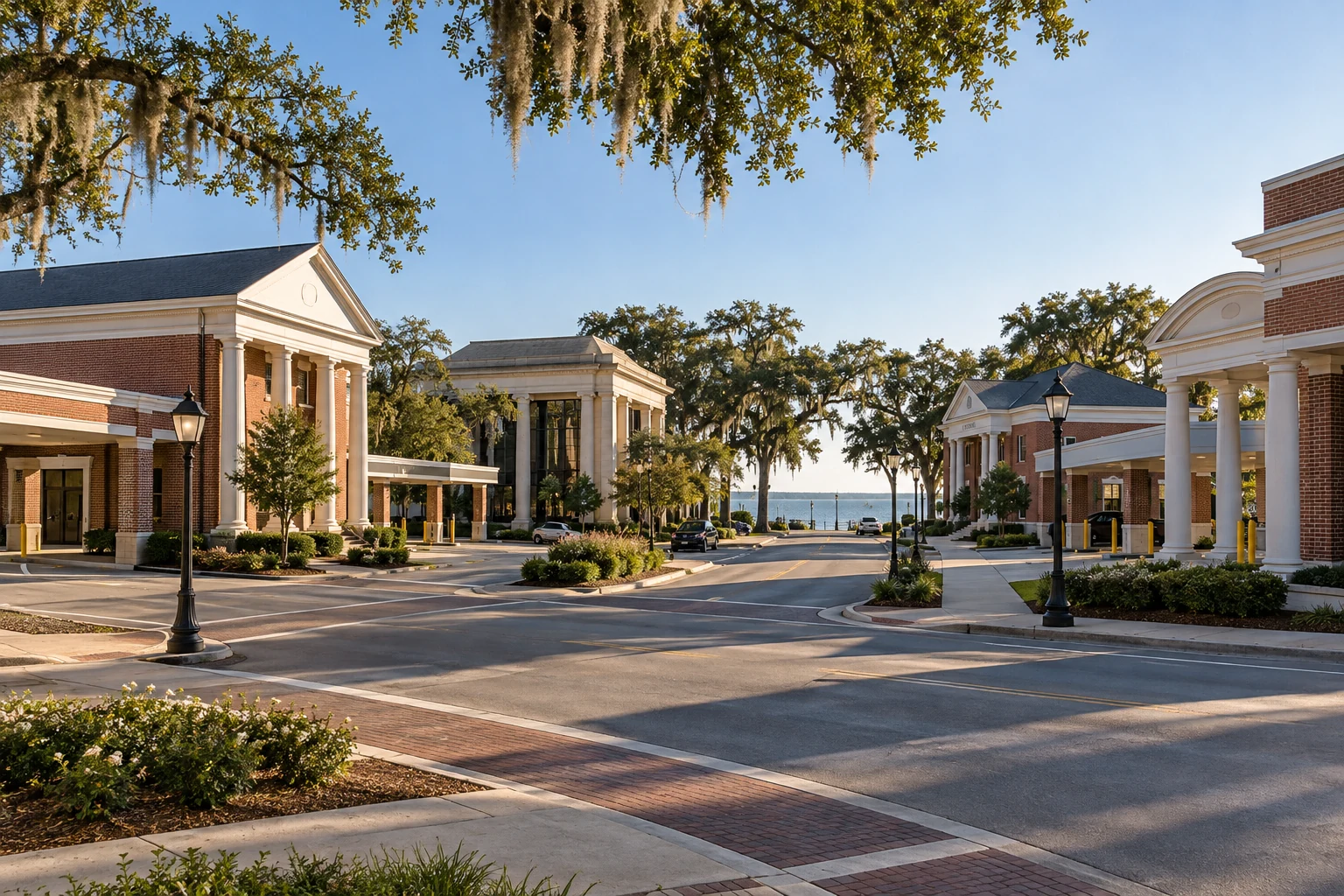
FAIRHOPE, AL — Civic leaders warned Wednesday that Fairhope could soon run out of places to put banks, threatening a development pattern residents have come to rely on whenever a restaurant closes, an empty lot appears or someone discovers an intersection with fewer than three drive-through lanes.
The warning followed the release of a fictional land-use survey finding that nearly every suitable corner is already occupied by a bank, being converted into a bank or enjoying a brief transitional period before becoming a bank.
“We are approaching peak branch,” said imaginary planning consultant Grant Ledger. “At the current rate, the next financial institution may have to go inside another financial institution. Nobody is prepared for that level of banking.”
In response, residents have formed Save Our Non-Banks, a fictional grassroots organization dedicated to preserving the city’s remaining restaurants, shops and unexplained little buildings before they acquire columns, a clock and a lane marked COMMERCIAL DEPOSITS.
An inventory of nonfinancial structures
The group’s first project is a citywide inventory of buildings where a person can still enter without being offered a home-equity line of credit.
Volunteers have been asked to photograph surviving non-banks from a respectful distance and note any early warning signs, including fresh brickwork, unusually confident landscaping or the sudden appearance of a small tower that serves no function beyond reassuring depositors.
“We found a sandwich shop that has been operating for eleven years without a vault,” said fictional organizer Penny Savings. “That kind of historic non-banking use deserves protection.”
The committee is also seeking emergency landmark status for a former gas station that remains a former gas station. Preservationists called the site exceptionally rare because it has not yet become a branch, urgent-care clinic or place to buy decorative lighting.
City staff stressed that the fictional bank shortage is not a crisis but acknowledged that available parcels are becoming difficult to locate.
One possible site is a narrow strip between two existing banks. Engineers believe a third bank could fit if its drive-through lanes are arranged vertically and customers agree not to open their doors.
Another proposal would create Fairhope’s first mixed-use financial district: a bank downstairs, a bank upstairs and luxury apartments advertised as “steps from liquidity.”
The last unbanked corner
Save Our Non-Banks has focused particular attention on what members call the last unbanked corner in town, a modest patch of grass currently serving no economic purpose beyond absorbing rainwater and giving drivers somewhere pleasant to look while waiting at the light.
Developers insist the property can support a tasteful 8,400-square-foot branch designed to resemble a much older bank.
“We would preserve the site’s character,” said fictional developer Buck Equity. “The live oak would remain visible in the rendering, and the ATM canopy would use historically sympathetic materials.”
Residents asked whether Fairhope needs another bank. Equity said that question had already been answered by the fact that there was room for one.
The project would also include four offices, six drive-through lanes and a conference room where residents could attend seminars on why nearby commercial rents keep rising.
At a fictional public meeting Tuesday, supporters argued that more banks would create competition. Opponents countered that the city already has enough competition to see which bank can build closest to another bank.
The debate ended when an attendee asked whether the proposed branch might contain a coffee shop. Both sides requested additional study.
Banking without boundaries
Consultants say Fairhope may eventually need to consider unconventional locations, including roundabout centers, the municipal pier and the decorative median where flowers are changed often enough to suggest active management.
One concept would place a small branch on a golf cart, allowing it to circulate downtown and accept deposits curbside. Another would convert unused portions of existing bank lobbies into smaller boutique banks for customers seeking a more intimate lending experience.
Save Our Non-Banks is urging residents to remain vigilant.
“If you know of a building that still sells food, repairs shoes or contains absolutely no financial services,” Savings said, “please enjoy it responsibly. It may be a bank by spring.”
At press time, the organization’s meeting space had been purchased by a regional lender and was being renovated to include tasteful columns.
Source note: This story is wholly fictional satire. Save Our Non-Banks and every named person, study, project, meeting and quotation are invented. The image is an original AI-generated editorial illustration and does not depict actual bank branches.
More Main Street arithmetic
Browse local-business satire and other commercial anxieties.