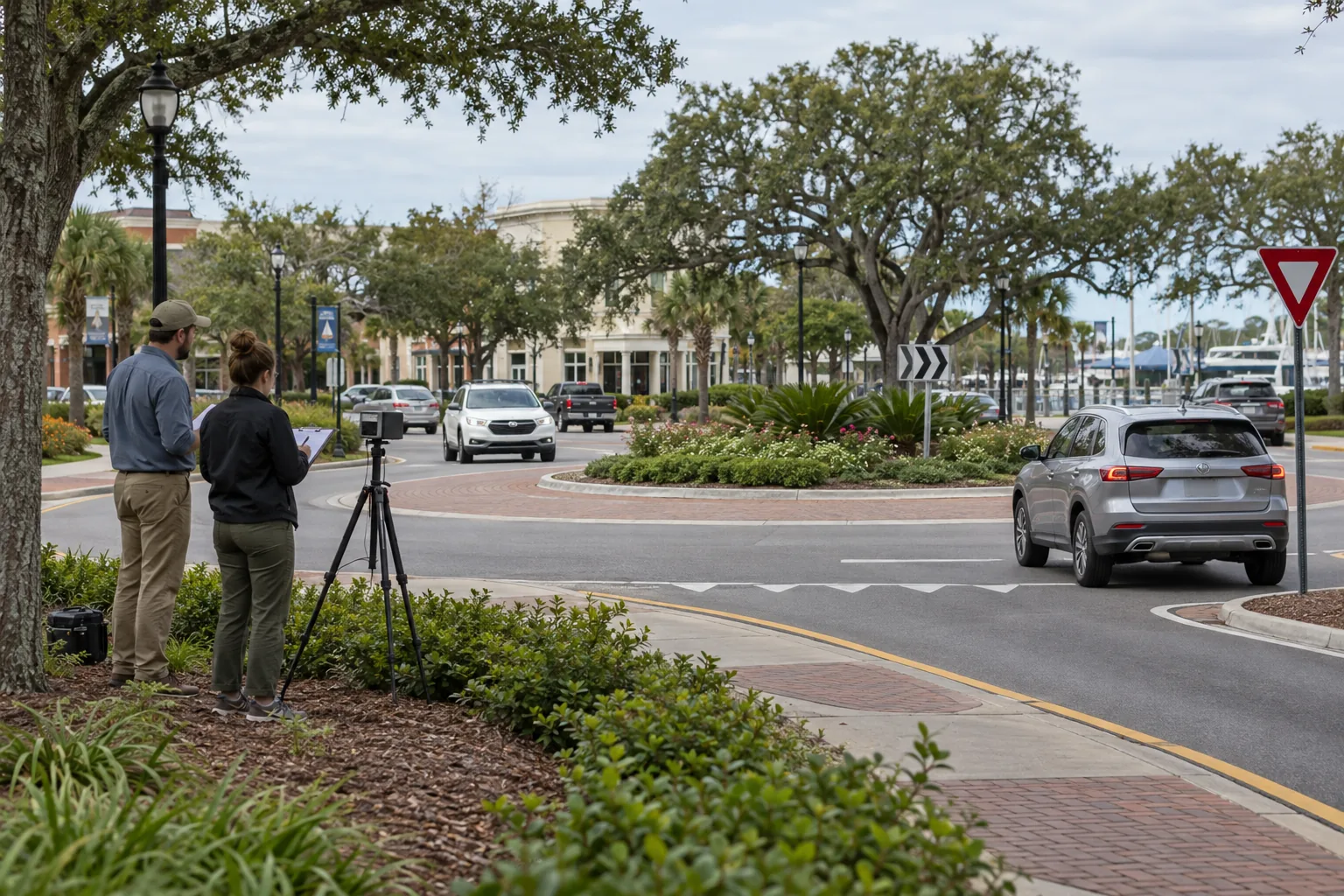
FAIRHOPE, AL — After months of field observation, a fictional team of Fairhope transportation scientists has concluded that the local roundabout remains completely unpredictable to approximately 37 percent of the population.
The finding was announced after researchers reviewed 2,400 approaches, 611 unnecessary full stops and one driver who entered the circle, activated a left turn signal and appeared to be waiting for further instructions.
“The geometry is stable,” said the study’s fictional lead researcher. “The variable is the moment a licensed adult sees a yield sign and forgets every event that led them there.”
Five distinct schools of thought
The team identified five dominant behaviors: Yield Normally, Stop Regardless, Accelerate Defensively, Wave Everyone Through and Enter Then Reconsider. A sixth category, Golf Cart Exceptionalism, remains under peer review.
Observed driver response
- 37%: roundabout considered unknowable
- 24%: yields to vehicles in other counties
- 18%: enters correctly but apologizes
- 13%: treats center island as a planning challenge
- 8%: has been circling since the study began
Researchers emphasized that the numbers total 100 percent only because one analyst took the spreadsheet home and refused to return until they did.
The most difficult behavior to model was the Courtesy Cascade. It begins when one driver with the right of way stops to wave in another driver, who then waves back, prompting a third vehicle to enter confidently while everyone else questions the nature of law.
“The roundabout is not confused. It knows exactly what it is doing.”
Proposed remedies include larger yield signs, smaller yield signs, a docent at each entrance and a mandatory ten-second instructional video played whenever a vehicle comes within 500 feet of the circle.
A more ambitious proposal would send the roundabout to the Planning Commission to determine whether it is historically appropriate. Researchers expect that option to produce a clear decision sometime after the next traffic study.
The team will continue its work until the unpredictability rate falls below 25 percent or the scientists themselves miss their exit.
Proceed when clear.
Then explain what “clear” meant at the public hearing.