FAIRHOPE, AL — Fairhope officials fictionally rezoned 12.65 acres of Residential/Agriculture property Monday after confirming that no crops, livestock or farm implements had filed a timely appeal.
The tract, located south of Morphy Avenue and west of County Road 13, will move into the Low-Density Single-Family Residential category, allowing the agricultural portion of its former designation to retire with full ceremonial honors.
“Agriculture had every opportunity to speak,” said imaginary zoning consultant Clay Loam. “We posted notice at City Hall, the Building Department, the Planning Department and the Nix Center. Not one soybean appeared.”
Loam said staff also mailed certified letters to the field, but the address came back as insufficiently subdivided.
Agricultural uses receive 30 days to vacate
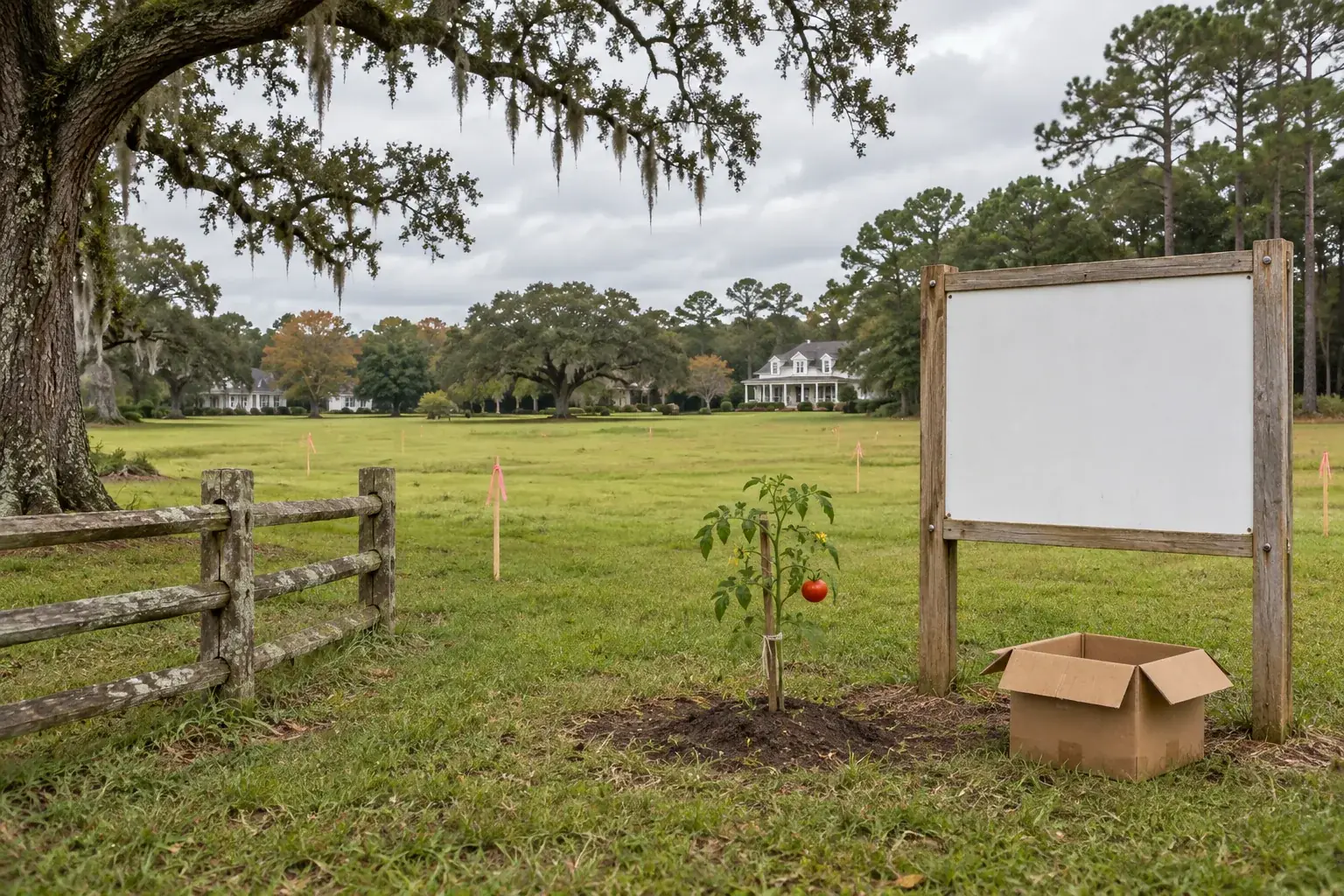
Under the fictional transition plan, the property's remaining agricultural character will have 30 days to gather its tomatoes and leave the premises.
One tomato plant near the road requested additional time, citing fruit production, established roots and the absence of any practical way to operate a moving truck.
The plant was granted a ceremonial cardboard box.
“We are not anti-tomato,” Loam said. “We simply believe the tomato would be more compatible in a raised bed maintained by a homeowners association.”
A riding mower was allowed to remain after agreeing to be reclassified as lawn-care equipment. A decorative tractor may also stay if it is permanently parked beside the entrance sign and never used for agriculture.
Any chicken found on the property after rezoning will be required to identify as a backyard amenity.
Rural character preserved in street names
Developers assured fictional residents that the land's farming history will be preserved through names including Soybean Trace, Former Pasture Court and Agricultural Memory Lane.
The subdivision entrance will feature a split-rail fence, a brick monument and one wagon wheel sourced from a store that has never been located near a farm.
“Nothing says rural character like a decorative object that would be ruined by actual rural activity,” said imaginary project representative Grant Acre.
Architectural guidelines will permit three approved shades of barn red, provided none are visible from the street.
Homes will include farmhouse sinks, farmhouse tables and framed photographs of barns located in other states. Actual barns will require a special exception and a drainage study.
Low density carefully defined
Officials emphasized that R-1 means low-density single-family residential development.
Residents asked what “low density” meant in units per acre, traffic movements and the number of roofs visible from Morphy Avenue.
Loam explained that low density is not a number so much as a reassuring tone used while pointing at a conceptual plan.
“You say it slowly,” he demonstrated. “Low. Density.”
The audience agreed that it sounded considerably roomier than it looked.
The fictional plan includes enough landscaping to ensure that each house will eventually be hidden by a tree planted after the house is built. Until then, residents are encouraged to imagine the mature canopy shown in the rendering.
Crops fail standing test
At the fictional hearing, a resident asked whether the field itself should be considered an affected party.
City counsel determined that the field lacked standing because it had remained in the same place for many years and had made no visible effort to attend.
The tomato plant attempted to submit written comments but produced only a small yellow flower.
“We need the application in PDF,” Loam said.
The field then observed three minutes of silence, which officials recorded as neither support nor opposition.
Farewell ceremony scheduled
Before the zoning change becomes effective in the fictional proceedings, the city will hold a farewell ceremony for the agricultural designation.
The program includes a reading of the old zoning map, the lowering of a feed-store cap and a final ceremonial use of the word “acreage” before the land becomes “homesites.”
Each future resident will receive a commemorative packet containing one seed, a photograph of the original field and a reminder that vegetable gardens must be screened from adjoining lots.
The tomato plant will be relocated to the subdivision clubhouse, where it will serve as the community garden until a committee can be formed.
At press time, officials were still waiting for the cows to appeal. Staff noted there had never been any cows, which satisfied the requirement that none had objected.